Nestbound

If you weren’t here tomorrow, who would work all this out?

Where the will is.Who to call first.Which account keeps the lights on.

You answer the questions now, over an afternoon or two. Your family gets a book they can pick up and follow, on the third day of a hospital stay or when you aren’t there to be asked.

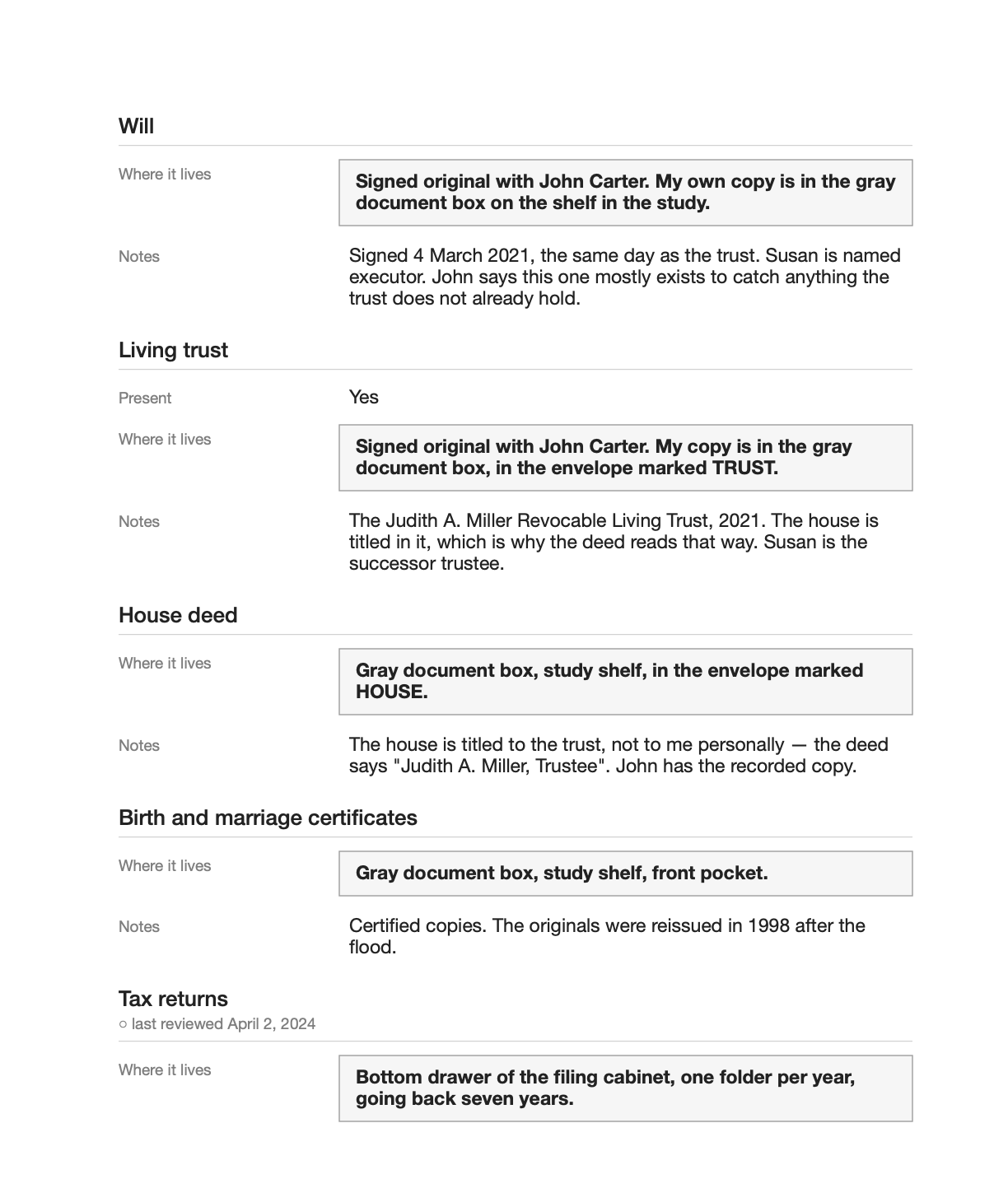
A page from a printed family binder headed Will, Living trust and House deed, with a boxed line under each saying where the paper is: the signed original with the attorney, the copy in the gray document box on the study shelf.

01 Where to start

Are you doing this for yourself, or for a parent?

One Sunday afternoon gets you a long way.

You already know most of the answers. They’re just scattered across a drawer, two email accounts, and the inside of your head. Most families build it up over a few sittings. It doesn’t come out as a folder for somebody to decode. It is a book with your family’s name on the cover, and the first thing in it is the short list of what needs doing.

Nestbound with a binder open. Down the left, twelve sections with a count beside each and a dot showing how far it has got: Personal & family, Key people, Documents & locations, Accounts inventory, Insurance, Property & keys, Digital life, Health, Pets, Wishes, Letters, First two weeks. In the middle, the five people under Key people. On the right, one of them open for editing, with their role, phone, email and a note reading “My daughter. She has agreed and knows where this binder is kept.”
A name, a number, and the line that matters: “She has agreed and knows where this binder is kept.”

Bring it to your next visit. There’s no hurry.

The questions change when the answers are somebody else’s. They turn into ones you can say out loud, and it prints a page of openers to take along. Take two to four sections at a time, the papers one Sunday and the people and the wishes another, then stop when the tea is finished. There’s no wrong order to do it in. The binder stays theirs: print it, hand it over, and leave a copy of the file where your family keeps things.

A planning sheet headed “What is this visit for?” It says to pick two to four things to cover, because an afternoon that tries to cover everything usually covers the easy third of it and stops. Twelve sections are listed with a checkbox each and a line under every one saying how much is left. Key people, Documents & locations and Insurance are ticked and marked “Start here”, with six, five and three still blank. Personal & family and Digital life read “Nothing left to ask”. At the bottom: Not now, Print the checklist…, Save the plan, and Start the visit.
You decide what this visit is for before you go, and take a printed list with you.

Or start from where you are: it’s your parents’ papers it’s your own you’ve been named executor

02 How it works

You don’t have to know what matters

That’s why most of these never get filled in: the binder bought with good intentions, still empty in a closet. Nestbound asks you. Nobody finishes in a single sitting, and nobody needs to.

Step 1

Answer what you can

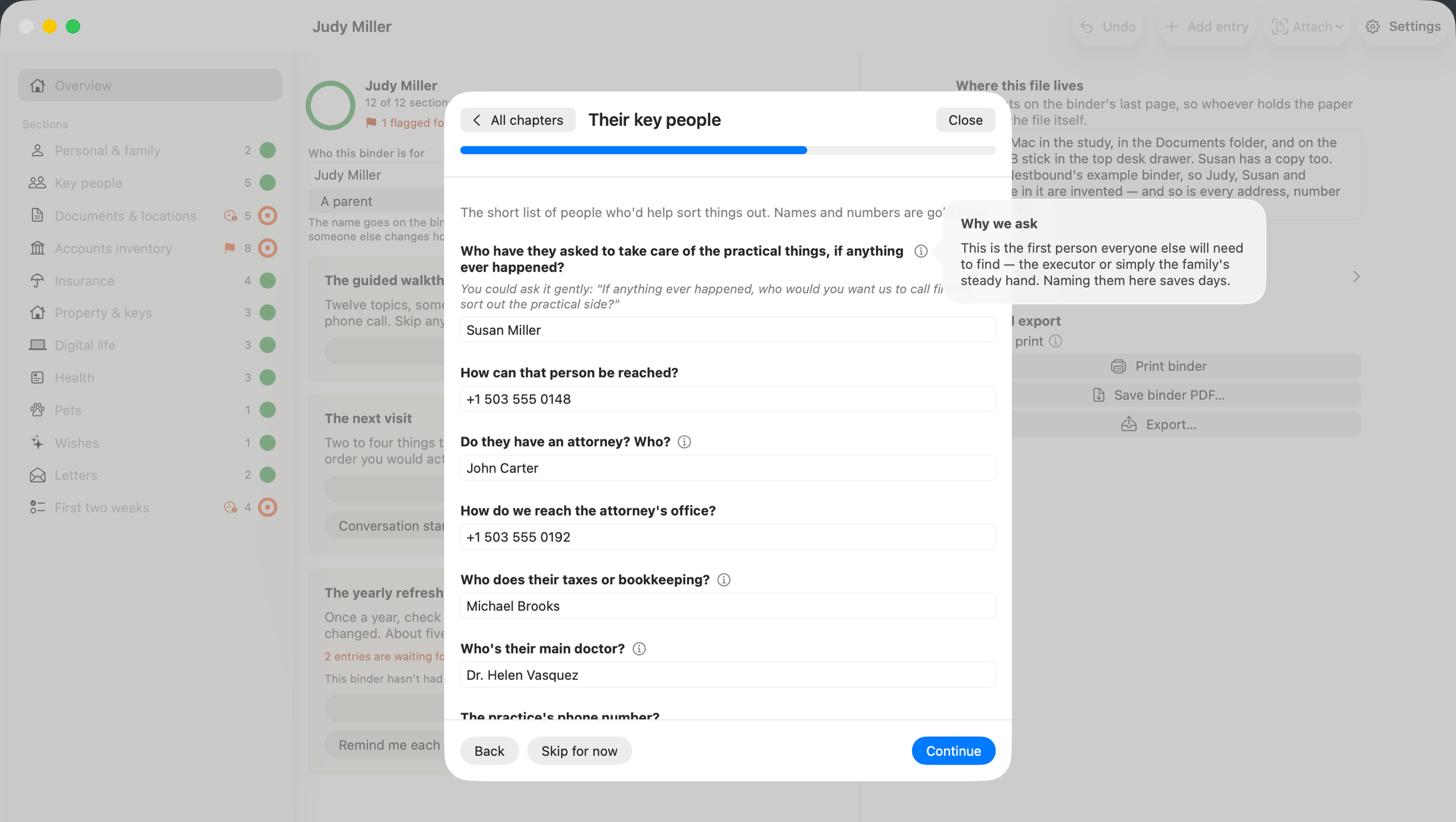
Where the will is kept. Who should be called first. Which neighbor has the spare key. One small thing at a time, in whatever order suits you, and anything at all can be skipped without explaining yourself to anybody. If you want to know why something is being asked, it will tell you. Shut the laptop halfway through a sentence and it will be waiting exactly there.

The walkthrough open on the chapter “Their key people”, with a progress bar across the top. The questions are worded for asking somebody else: “Who have they asked to take care of the practical things, if anything ever happened?”, and under it a suggested way to put it, “You could ask it gently: if anything ever happened, who would you want us to call first to sort out the practical side?” A small note headed “Why we ask” is open beside it. Answers are filled in below: a name, a phone number, an attorney, a doctor. At the bottom, Back, Skip for now, and Continue.
A question, and the note beside it saying why it is being asked.

Step 2

Photograph the paperwork

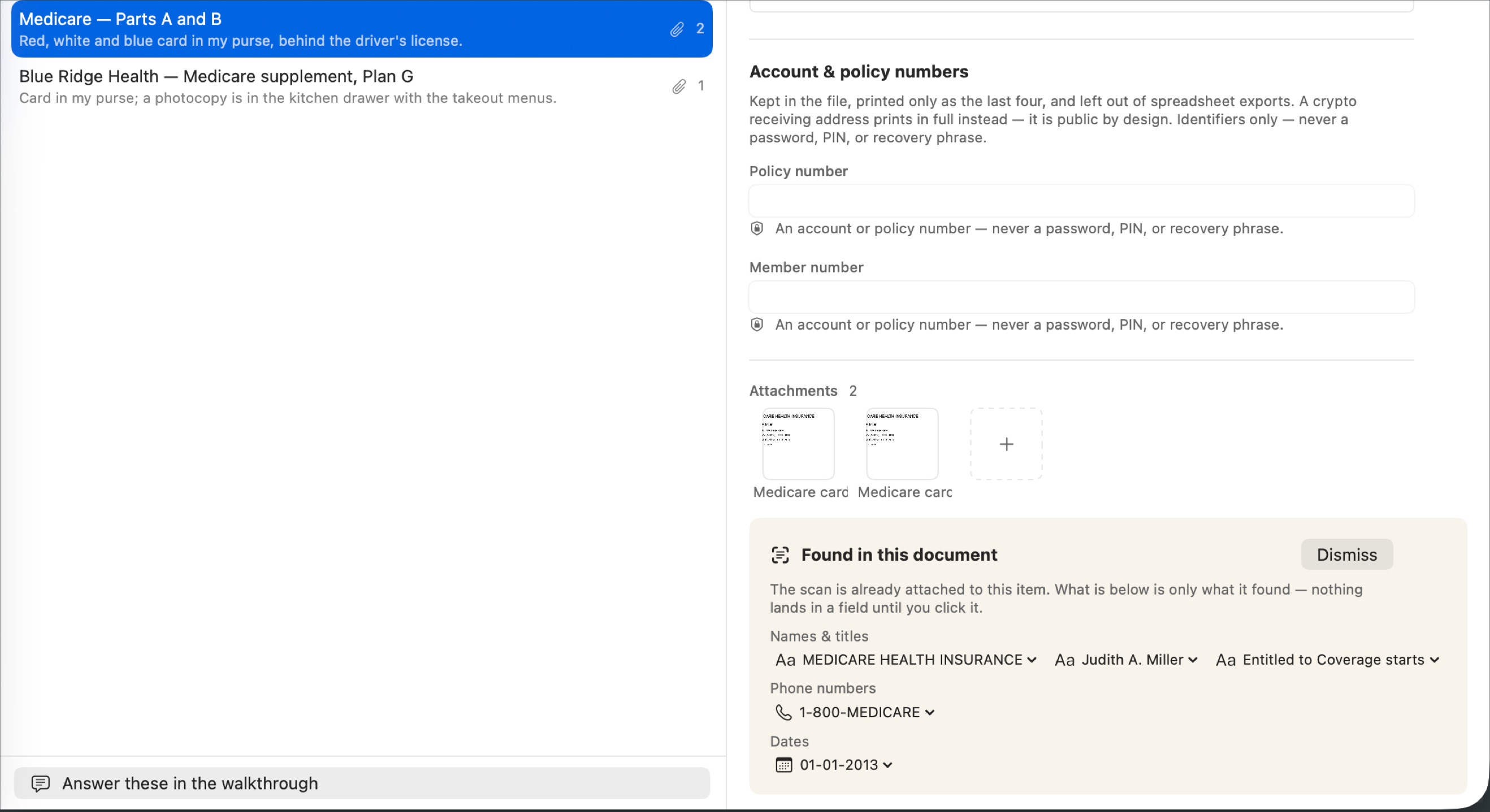
Take a picture of a statement or a policy with the phone in your pocket, then bring it in on the Mac and say which entry it belongs to. A scan you already have works the same way. Nestbound reads the page on your own Mac and offers you what it found: the carrier, an agent’s number, a renewal date. Keep what’s useful and wave off the rest. It never asks for a password, a PIN or the combination to anything. There’s nowhere to put one, and there never will be.

An insurance entry in Nestbound with a photographed Medicare card attached. A panel headed “Found in this document” lists what the Mac read off the scan as separate suggestions: names and titles, a phone number, a date. A line above it says the scan is already attached and that nothing lands in a field until you click it. The account and policy number fields are labeled “An account or policy number, never a password, PIN, or recovery phrase.”
A photographed policy, with the details it picked out listed beside it.

Step 3

Print the book

The whole thing comes out in one go: a cover with your family’s name on it, a divider for every section, typed pages behind each one, and your photographs at the back. Every page is numbered and carries the family name, so nobody is left wondering whether pages are missing, or who a loose one belongs to. Next year you reprint the pages that changed and swap them in.

A printed binder page from the first section. A paragraph explaining that most institutions ask for the same two things, certified copies of the death certificate and a document showing authority to act. Then a list headed “In roughly this order”, and typed entries for who to tell first, which account the first weeks’ money comes from, and what the house needs.
A page of the finished book. You can also save the whole thing as a file, and send a copy to whoever else should have one.

03 The binder

The book that ends up on the shelf

Typed, tabbed, dated, and readable by anyone who picks it up.

What your family finds in it

You fill in whatever applies to you and leave the rest. A half-finished one is worth far more than the drawer it replaces, and most of them start that way.

  1. The first two weeks Who to call, and what each of them will ask for.
  2. Personal & family Names, dates, and the paperwork that proves them.
  3. People to call Executor, attorney, accountant, doctor, the neighbor with the spare key.
  4. Papers & where they live The will, the deeds, the certificates, and which drawer each one is in.
  5. Accounts at a glance Which institutions, what kind of account, and the numbers that name them. Never a password or a PIN.
  6. Insurance Carriers, policy types, where the paperwork lives, who the agent is.
  7. Home, vehicles & keys Titles, storage units, safes, and where the keys are kept.
  8. Digital life The services that matter, and where the password manager’s emergency kit is.
  9. Health at a glance Medications, providers, and where the directives are filed.
  10. The animals Vet, food, medication, habits, and who has agreed to take them.
  11. Wishes How you’d like things done, in your own words.
  12. Letters Who you’ve written to, and where those letters are kept. Sealed stays sealed; nothing personal is copied into the binder.

All you need is a printer and an ordinary three-ring binder from any office shop.

Then it goes on a shelf

You print it, put it on a shelf, and tell one person where it is. Your wishes are in there in your own words, so nobody has to guess at them.

And you get to stop thinking about it.

The first tab isn’t a list of what you own. It’s a list of what somebody has to do, in roughly the order it comes up, so whoever opens the binder has a next thing to do rather than a pile to sort.

Three pages from it, and you can read every one: the whole example binder.

A binder cover page. A small letterspaced kicker reading “The family binder”, the Nestbound family tree printed small in gray beneath it, then the name Judy Miller set large in a serif face, a short rule, and the italic line “Prepared with love.” A gray line along the bottom reads “2 pages may be worth a fresh look”.
The cover. The family’s name, the date it was printed, and nothing clever.
A section divider page headed “The first two weeks”, with an italic standfirst reading “Who to tell, where the first weeks’ money comes from, and what the household needs. Written for you, in advance, so the practical side does not all land at once.” Below it, a count reading “4 entries”.
The first tab, before everything else: what needs doing in the first two weeks, and who to call about each of it.
A typed contacts page. Five people, each a name as a heading with label-and-value rows beneath: Susan Miller, role “Executor / steady hand”, with a phone number, an email and the note “My daughter. She has agreed and knows where this binder is kept.”; then John Carter, attorney at Carter & Hayes LLP, who holds the signed original of the will; Michael Brooks, accountant at Brooks & Associates CPA; Dr. Helen Vasquez, doctor; and Dave and Carol Byrne, “Neighbor with a key”.
Typed, so nobody is squinting at handwriting at eleven at night. Name, role, how to reach them, and a line on who they are to you.

04 What you keep

You keep the binder. Your family keeps the answers.

The binder on the shelf, and the file it came from. Yours to keep, to copy and to hand on.